The Rusted Chain: Entropy, Progress, and the Lambda View of Systems
A reflection on entropy, carrying capacity, and Lambda as a pressure-awareness framework.
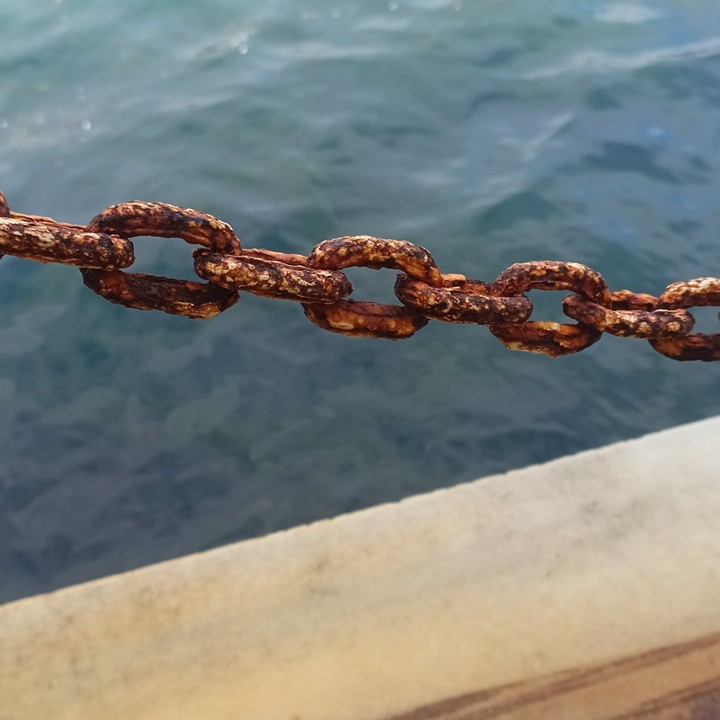
At the edge of the sea, we see a rusted chain.
At first glance, it is a simple image: metal exposed to saltwater, oxygen, humidity, and time. Science can describe the process with precision. Iron oxidizes. The surface changes. The structure weakens. If the process continues long enough, the chain may eventually break.
But this image is not only a chemical event.
The rusted chain reveals something deeper: no form is exempt from flow.
A chain is a form. A company is a form. A market is a form. A human mind is a form. Institutions, economies, societies, and civilizations are also forms at different scales.
Every form comes into existence with a carrying capacity. This capacity is shaped by its internal structure, its relationship with the environment, its ability to adapt, and the pressure it receives from outside. As long as a form can sustain that capacity, it remains coherent. But when internal and external pressures exceed what the form can carry, it begins to transform.
Rust is not merely a color on the surface of metal. Rust is the visible trace of a form losing its ability to remain what it once was.
Entropy as the Trace of Transformation
Entropy is often described as disorder, decay, or the tendency of systems to move toward less structured states.
But from the perspective of motion, entropy can also be read as something more subtle:
Entropy is the visible trace of transformation on a form.
The chain is not disappearing into nothingness. It is being rewritten. Its metallic structure enters a new relationship with water, oxygen, salt, air, and time. What we call rust is the visible memory of that interaction.
For the form, this may look like decay.
For nature, it is transformation.
For motion, it is continuity.
The form wants to remain itself. The flow does not promise that.
This is the critical point: progress does not preserve every form forever. Progress produces forms, tests them, pressures them, and transforms them when their carrying capacity is exhausted.
Progress creates form, but it does not immortalize form.
Time: The Human Reading of Transformation
Human knowledge often reads transformation as time.
We say: “The chain rusted over time.”
This is correct at the level of observation. But a deeper reading is possible. What we call time may be the way human perception organizes transformation into sequence.
The chain did not simply wait and then rust. It remained in continuous interaction with its environment. The rust is not merely the result of time passing. It is the result of transformation becoming visible.
Science can describe the stages of corrosion. Motion Theory asks what lies beneath those stages.
It asks:
- What is changing?
- What carries the change?
- What is the form trying to preserve?
- At what point does the form lose its ability to remain what it was?
From Rusted Chains to Companies
Now consider a company.
A company may look strong from the outside. It may have revenue, customers, infrastructure, reputation, talent, market share, and history. But like the chain, it is constantly exposed to forces: technology shifts, customer behavior, regulation, capital pressure, competition, internal complexity, cultural fatigue, decision delays, and strategic misalignment.
A company does not collapse only because a competitor appears. It collapses when its existing form can no longer carry the pressure of the environment.
This is why large companies continuously reinvent themselves. They know, implicitly or explicitly, that size is not immunity. A larger chain can still rust. A larger organization can still become fragile.
The real question is not:
Is this company big?
The deeper question is:
Can this company still carry the transformation pressure around it?
If the answer is yes, the company can renew itself. If the answer is no, the company begins to rust.
The Carrying Capacity of Forms
Every form has a carrying capacity.
A chain can carry weight until its structure weakens. A mind can carry pressure until its inner flow breaks. A market can carry leverage until liquidity and trust fail. A company can carry complexity until adaptation slows. A society can carry tension until coherence dissolves.
The carrying capacity of a form is not fixed forever. It can be renewed, strengthened, extended, and reorganized. But it must be fed by adaptation.
A form survives not by refusing change, but by transforming before it breaks.
A form lives as long as it can carry progress.
When a form aligns with the direction of progress, it can become stronger. When it resists progress, it becomes brittle. When it ignores pressure, it rusts silently. When it reads pressure early, it can renew itself.
Lambda: A Gauge of Pressure Before Collapse
This is where Lambda enters.
Lambda is not merely a financial metric. It is not limited to markets. It is a general pressure-reading framework for systems.
Lambda asks:
Can this system still sustain its current form under the pressure it carries?
In finance, Lambda-F looks at markets and asks whether the current market structure can still carry the accumulated pressure of leverage, fear, liquidity shifts, volatility, and sentiment.
In Flux Signal, Lambda-S reads market-state pressure before visible volatility dominates the surface.
In Flow Observatory, Lambda-C reads corporate and sector flow: whether a company or sector can still sustain its current operating form under structural and market pressure.
In Flux Mind, Lambda-M looks at human mental momentum: whether a person’s inner state can carry activity, resistance, mood, and pressure without losing flow.
In Corporate Lambda Reading, Lambda asks whether an organization’s governance structure can continue under uncertainty, tension, complexity, and limited adaptive capacity.
Across all these domains, the question is the same:
Is the form still carrying the pressure, or is it beginning to rust?
Economic Rust
Markets also rust.
Not physically, but structurally.
Economic rust appears as hidden fragility: excessive leverage, liquidity thinning, unstable confidence, delayed decisions, crowded positioning, fragile correlations, and rising sensitivity to shocks.
A market may look healthy while rust is forming underneath. Prices may continue upward. Volatility may remain quiet. Reports may look strong. But beneath the surface, the system may be losing carrying capacity.
Lambda does not try to predict the exact moment of collapse.
It tries to make visible the conditions under which the current form may no longer continue as it is.
This is why Lambda is not a prediction engine. It is a pressure-awareness layer.
It does not ask only:
What will happen?
It asks:
How much longer can this form carry what it is carrying?
The Rusted Chain as a Systemic Lesson
The rusted chain teaches us something simple and profound.
A form may appear solid. But solidity is not permanence.
Every form is a temporary organization of deeper motion. The chain is not merely a chain. It is a visible agreement between matter, environment, structure, and time. When that agreement weakens, rust appears.
The same is true for companies, markets, minds, and institutions.
A system does not fail only when it breaks. It begins to fail when it can no longer renew its carrying capacity.
That is the moment Lambda tries to read.
Final Thought
Progress is not always gentle to forms.
It creates them, tests them, pressures them, and eventually transforms them. A form that aligns with progress may become stronger. A form that resists progress may decay. A form that cannot read pressure may collapse without understanding why.
The rusted chain is not silent.
I was once a form.
I carried weight.
I met the sea.
I entered transformation.
My rust is not only decay.
It is the visible signature of motion.
Lambda exists to read similar signatures in living systems, financial systems, corporate systems, and human systems before the break becomes visible.
Every system has a carrying capacity.
Every form, sooner or later, must answer to progress.